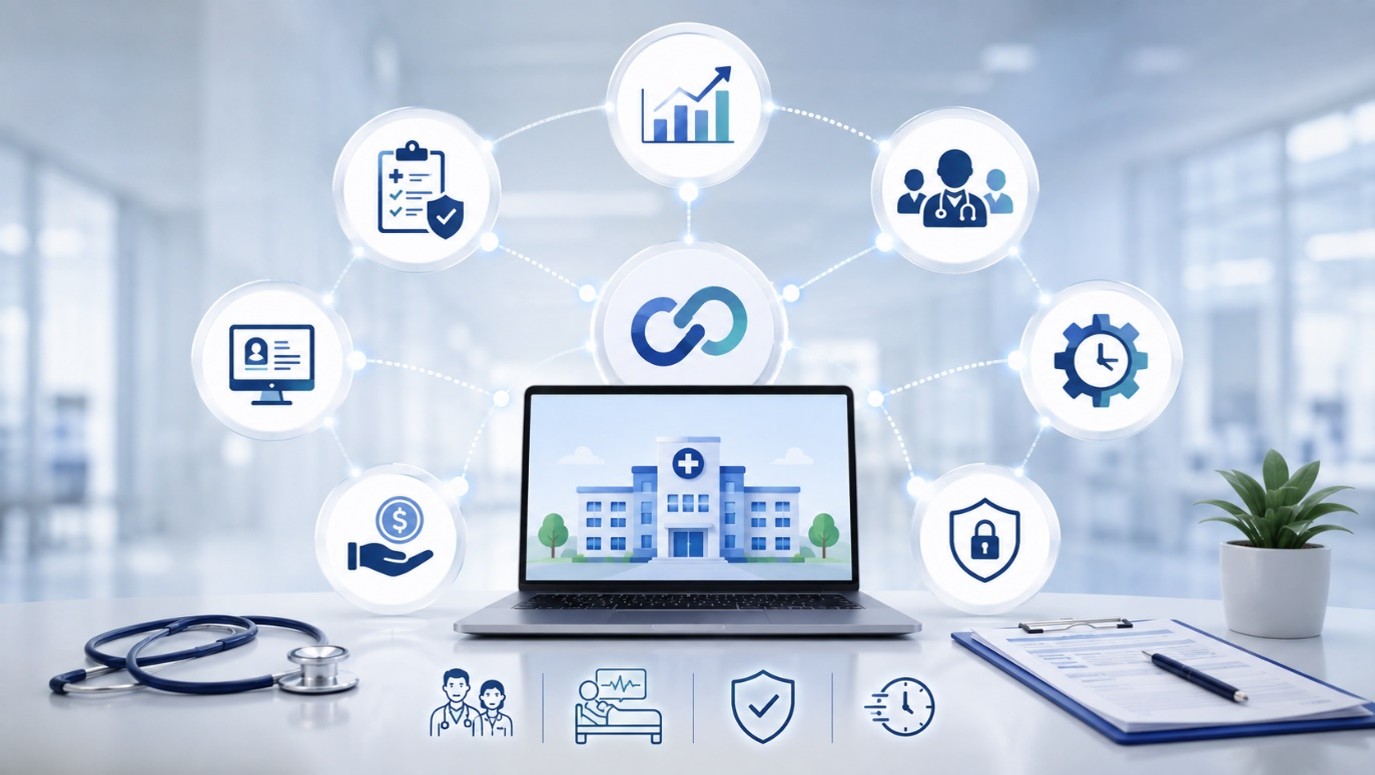
Hospitals depend on two closely-linked functions to run well. Clinical workflows take care of patients; administrative workflows handle appointments, payments, records, and compliance. When these functions run on different systems, hospitals usually experience delays, missing data, and confusion in day-to-day operations.
Hospitals are finding it easier to handle these problems — and work better — by using one digital platform to take care of both patient care and office work at the same time.
Better coordination across departments
In many healthcare settings, different departments use different tools. That leads to repeated data entry, mismatched records, and constant back-and-forth between teams.
A single platform lets every department work off the same system. When a patient provides their information during registration, it’s immediately accessible to doctors, nurses, and the billing team. Any change made by one department is visible to the others in real time. That cuts miscommunication and helps teams collaborate.
Improved clinical efficiency
Doctors and clinical staff need fast, reliable access to accurate patient information. When important details are spread across systems or paper documents, time gets wasted just tracking things down.
A single platform gives a full picture of the patient — medical history, doctor visits, test results, medication orders, and care plans — all in one place. Clinicians decide faster and spend more time on the patient instead of on paperwork.
Reduced administrative workload
Administrative staff take care of the tasks that keep the hospital running. Managing appointments, admissions, billing, and reports becomes hard when the systems aren’t connected.
A single platform absorbs many routine tasks and cuts repetitive work. Data moves from clinical notes into billing and reports without manual re-entry. Staff handle more work, faster, with fewer errors.
More accurate billing and financial control
Billing is one of the most delicate parts of how a hospital runs. Errors or delays cause patient dissatisfaction and lost revenue.
When clinical and administrative processes are linked, billing details are collected automatically as services are provided. Bills are more accurate, charges are easier for both hospitals and patients to understand, and finance teams get a clearer view of how revenue actually moves.
Better data visibility and reporting
Hospital leaders need clear information to make good decisions. When systems aren’t connected, reports arrive late or come in incomplete.
A single platform brings clinical and administrative data together. Real-time dashboards and organised reports show patient volumes, resource use, and operational performance — enabling better planning and on-time decisions.
Enhanced patient experience
Operational efficiency directly affects patient experience. Long waits, forms filled out again and again, and billing surprises usually come from a disconnected workflow.
A unified system means easier registration, better care coordination, and clearer communication. The patient’s journey feels planned and less anxious — which builds confidence in the hospital and the care being delivered.
Supporting scalable growth
As hospitals grow, complexity gets harder to manage. Adding new departments or services can put stress on the existing setup.
A single integrated system scales more cleanly because every step follows the same pattern and every piece of data lives in one place. Hospitals add services without adding chaos — and that is what makes long-term sustainability possible.
The role of integrated hospital platforms
All-in-one EHR and HIS solutions make this unified approach possible. Platforms like Doctor 24By7 are built to support both patient care and hospital operations from a single system — so hospitals can manage more of their work while staying in control of it.
The goal isn’t digital tools for the sake of it. It’s making everyone in the organisation work in the same direction.
Conclusion
Using one platform for both clinical and administrative tasks changes how hospitals run. It improves teamwork, streamlines work, gives clearer data visibility, and leads to better patient care.
By bringing systems together, hospitals spend less time managing tasks and more time providing high-quality care — confidently and efficiently.