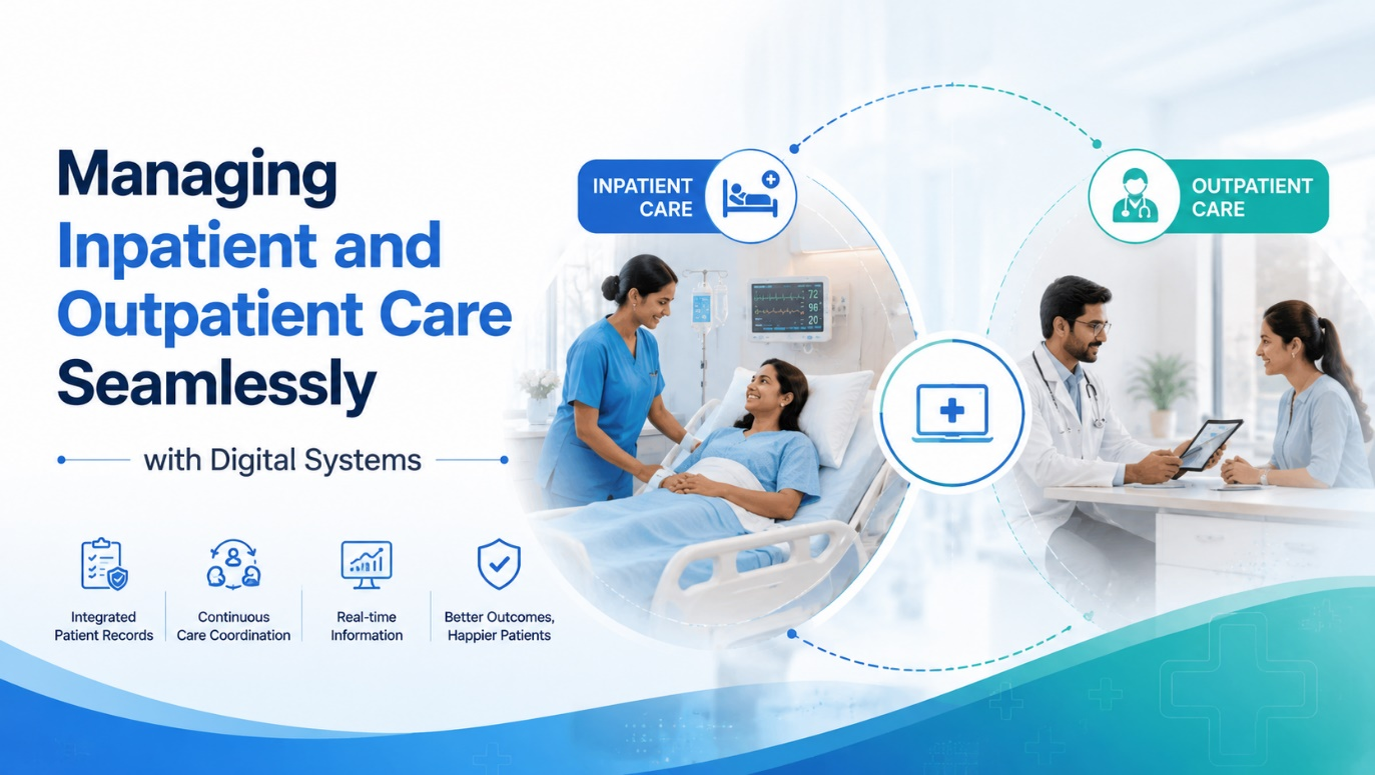
Hospitals today handle two very different care journeys at the same time — outpatient visits that move quickly, and inpatient care that unfolds over days or weeks. While both aim for the same outcome (better patient health), the way they operate is vastly different. Managing these journeys smoothly, without confusion or delays, has become one of the biggest operational challenges for healthcare providers.
This is where digital systems are quietly reshaping how hospitals function.
The complexity of dual care models
Outpatient care is fast-paced. Patients arrive, consult, receive treatment or prescriptions, and leave — often within hours. Inpatient care, on the other hand, involves admissions, bed management, nursing notes, investigations, procedures, discharge planning, and continuous monitoring.
When these two care models are managed through disconnected systems or manual processes, gaps begin to appear. Patient records get fragmented. Updates are delayed. Coordination between departments becomes difficult. What should be a smooth continuum of care starts feeling disjointed — for both staff and patients.
One patient, one digital journey
A key advantage of digital hospital systems is their ability to treat inpatient and outpatient care as parts of a single patient journey, rather than isolated events. With a unified EHR and HIS platform, patient information flows naturally from OPD to IPD and back again, without repetition or loss of data.
A patient seen in the outpatient department can be admitted seamlessly, with their clinical history, investigations, and notes already available to the inpatient team. After discharge, follow-up visits continue on the same digital record. This continuity not only saves time but also improves clinical decision-making.
Simplifying workflows for care teams
Doctors, nurses, and administrative staff often work under immense pressure. Switching between systems — or worse, paperwork — adds unnecessary friction to their day.
Digital systems simplify this by aligning workflows across departments. Appointments, admissions, bed availability, treatment orders, and billing are all connected. Role-based access ensures that each team member sees what they need, when they need it — nothing more, nothing less.
This clarity reduces handover errors, speeds up routine tasks, and lets healthcare professionals spend more time with patients rather than screens.
Real-time visibility, better coordination
Managing inpatient and outpatient care effectively requires real-time visibility. Administrators need to know how many patients are waiting, how many beds are occupied, and where resources are stretched.
Digital dashboards and reports provide this insight instantly. Whether it’s tracking OPD volumes, monitoring inpatient occupancy, or planning discharges, data-driven visibility helps hospitals respond faster and plan smarter. Instead of reacting to problems after they arise, teams can anticipate and prevent them.
Enhancing the patient experience
For patients, seamless care isn’t about software — it’s about how smoothly their experience feels. Repeating the same information at every counter, waiting unnecessarily, or facing billing confusion can quickly erode trust.
Digital systems reduce these friction points. Faster registrations, coordinated care transitions, and clear billing processes make the patient journey more comfortable and reassuring. When systems work in the background, patients feel supported rather than processed.
The role of integrated digital platforms
An all-in-one EHR and HIS platform plays a crucial role in bringing inpatient and outpatient care together. Solutions like Doctor 24By7 are built to support this integration — connecting clinical documentation, administrative workflows, and operational oversight within a single system.
The focus isn’t just on digitising records, but on creating a cohesive care environment where information flows smoothly and teams stay aligned.
Conclusion
Managing inpatient and outpatient care doesn’t have to mean managing complexity. With the right digital systems in place, hospitals can bridge the gap between fast-moving OPD workflows and detailed inpatient care — without compromising on accuracy or efficiency.
When care journeys are connected, teams work better, patients feel more confident, and hospitals move closer to what truly matters: delivering consistent, high-quality care at every stage.